

What's the Best Engine Coolant & Water for Max Protection?
The Ultimate Engine Coolant for Racing & High-Performance Vehicles
Estimated reading time 10:30
So, what is the best engine coolant for high-performance engines? If you’re new to racing, you might wonder if you can use water as coolant. Asphalt tracks don’t allow glycol-based coolants. Thus, most racers use plain water in their cooling system. Glycol is slippery and creates a hazard if spilled on the track.
Maybe you’ve thought, “What’s the best engine coolant for my race vehicle? Is there something better than straight water?” Today, high-performance race engines generate more heat than ever. They need an engine coolant that provides greater heat transfer to remain cool, prevent overheating, and perform at optimal levels under all conditions.
Two key ingredients determine a coolant’s effectiveness. One is water quality. The other is wetting agents. High quality water + multiple wetting agents = the best engine coolant for racing applications and high-performance engines.
When you run hard on a race track, it’s crucial you use a premium high-performance coolant to protect your system. We’ll discuss the importance of water quality and wetting agents in this article.
Water does transfer about two times more heat than glycol, but it’s not the best engine coolant for racing. The problem is water causes corrosion. It also causes scales, deposits, and electrolysis in the cooling system over time.
Best Engine Coolant Water
Before we discuss the best coolant for racing applications, we need to address one topic. What is the best engine coolant water? There are several different types of water you could use. We’ll look at the options.
Most race tracks are in rural areas and source their water from wells. The well water quality is poor because it contains several contaminants. The list includes iron, sulfur, and other things that speed up the corrosion of metals in a cooling system.
Let’s dive in and look at the different engine coolant water sources:
Tap Water – Comes from your local municipal water treatment plant. They source tap water from rivers, lakes, streams, ponds, springs, and desalinated seawater. Can you use tap water as engine coolant? We don’t recommend it. Tap water is not the best engine coolant choice because of water hardness. That’s common for most tap water.
Hardness is one of the most problematic issues for cooling systems. In engine coolant, hardness drops out of solution and bakes onto hot surfaces inside cylinder heads and radiators. This results in scales and deposits forming. Scales and deposits reduce heat transfer, and over time lead to overheating and possible engine damage. In fact, only 1/16″ thick scales can reduce heat transfer by up to 40%!
There are a couple of other reasons why you shouldn’t use tap water as a car coolant:
– CHLORIDE ION
A derivative of desalinated water. Desalinated water is common in coastal areas where fresh water is not as abundant.
Desalination removes salt (sodium chloride). The process makes seawater drinkable. But, the process leaves chloride ion from the salt behind. Chloride in engine coolant water is a big problem for a couple of reasons:
A chloride ion is quite small. On a molecular level, it can penetrate the matrix structure of aluminum alloy. This causes intergranular corrosion. In severe cases, this type of corrosion accelerates as it goes further into the metal.
Chloride ion can combine with hydrogen in water to form hydrochloric acid. This reduces the pH of engine coolant and makes it acidic and corrosive to system metals.
ASTM D3306 is the standard engine coolant specification followed by all OEMs. It lists the maximum allowable chloride at 25 ppm. Generally, tap water from municipal desalination plants contains 50-100+ ppm of chloride.
– CHLORINE
Used by municipalities to disinfect source water. Tap water can become acidic due to chlorine. Without getting too technical, municipalities sometimes over-chlorinate water to achieve proper disinfection.
The process leads to the formation of chloroacetic acids. When water is recirculated in a cooling system through repeated heat/cool cycles, the chloroacetic acids reduce the pH of the coolant. It makes it acidic and corrosive to system metals.
Well Water – We already mentioned why this is not the best engine coolant water. But, you might wonder if it’s alright to use treated well water. The problem with treated well water is that treatment options and quality output vary. Iron from well water will deposit on hot surfaces inside cooling systems. The sulfur forms sulfuric acid. The acid reduces the pH of the coolant and accelerates corrosion.
Rainwater – Not only does rainwater contain environmental contaminants, but it’s also acidic. This is particularly true if you live near the ocean, coal-fired power plants, or urban areas with smog.
Softened Water – Domestic water softeners are not the most sophisticated water purification devices. Depending on how well they are made, maintained, and regenerated, they can allow enough corrosion-causing chloride ion to bleed through. This can ruin a cooling system. Also, domestic water softeners leave other contaminants behind. Those contaminants can wreak havoc on a cooling system. Softened water is excellent for bathing and drinking, but it’s not the best engine coolant water.
Distilled Water – Some people use distilled water for coolant. If you’ve owned an iron, you know they suggest using distilled water. You might think it would be an excellent choice for coolant. Not true. Distilled water is produced when they boil water into vapor. The steam is converted back into liquid. The process leaves salts and minerals and kills bio-contaminants.Immediately after distillation, water has a neutral pH balance of 7. But, it soon becomes acidic. Why? Distilled water is electrochemically imbalanced; it aggressively absorbs anything to regain electrochemical balance.
Carbon dioxide is the most common material (“food source”) found in the environment. Thus, it’s a perfect food source. Freshly distilled water absorbs carbon dioxide until it reaches equilibrium with the atmosphere. When it enters the solution, carbon dioxide reacts with water to produce carbonic acids.
“Ionically hungry” distilled water slowly dissolves metals. It pits thicker surfaces, like cylinder heads, and causes pinhole leaks in thinner surfaces, like radiator tubes.
Deionized (DI) Water – Occurs when water passes through cation and anion exchange resins. Similar to distilled water, deionized water is electrochemically imbalanced and ionically hungry.
Filtered Water – They use various methods to filter water. None does a good job at removing enough chloride ions. We already discussed chloride ions in relation to tap water.
Reverse Osmosis (RO) Water – This is the best engine coolant water for racing applications. Why? Because RO is by far the most sophisticated water purification method. Reverse osmosis removes almost all types of dissolved and suspended chemical compounds and biological ones. They use RO water in industries requiring extremely pure water. Microchip production is great example. RO is also used for purified drinking water.
Reverse osmosis produces ultra-pure, electrochemically stable, and balanced water. That’s critical for engine coolant. Another benefit of RO is it removes 100% of chloride ion from water.
Distilled & DI Water with Antifreeze
You can safely use distilled or deionized water in a 50/50 antifreeze mix. It’s because the glycol and other chemicals in antifreeze maintain the electrochemical balance.
Antifreeze also has reserve alkalinity that protects against carbonic acid. There’s another important point you should know. Antifreeze has half the water compared to straight water coolant. This mitigates the harmful effects of distilled or deionized water.
Straight Water Coolant vs. Antifreeze
As we discussed, you can’t use antifreeze for asphalt racing because the slippery glycol poses a track hazard if it leaks or spills. What about if you race on dirt? Straight water coolant still offers multiple advantages vs. antifreeze in a cooling system:
Has a higher specific heat capacity, allowing for more efficient and effective heat transfer. Glycol, blended in antifreeze, is not good at conducting heat.
Is lower viscosity, allowing it to flow more rapidly through radiator tubes.
It won’t gel in engine oil and damage bearings if coolant seeps into the crankcase, unlike antifreeze.
It has no glycol, so it doesn’t create dangerous slippery track conditions when/if coolant leaks occur.
Stay Frosty® Race Ready
The Best Racing Coolant
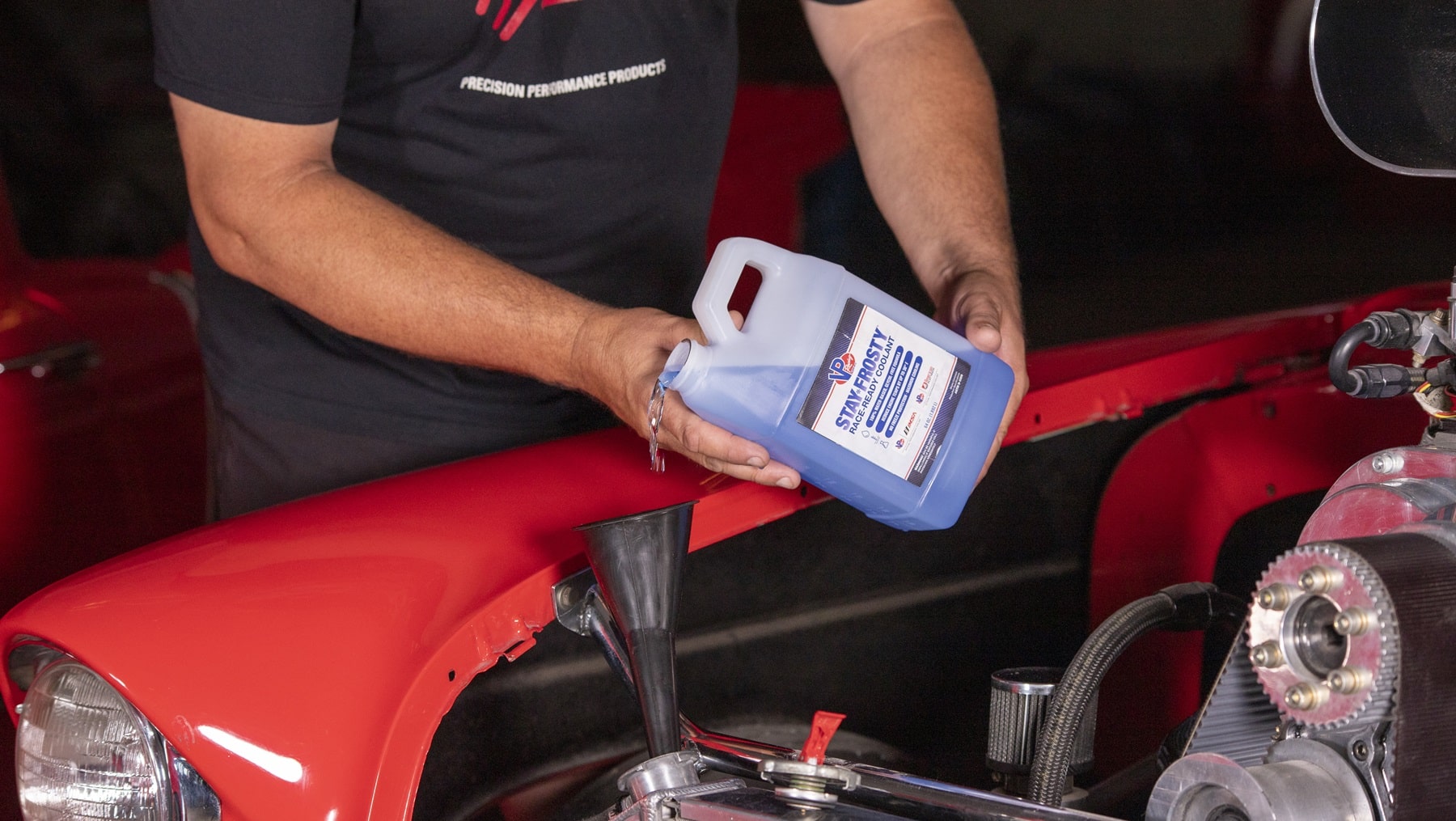
Unless you live in a location with temperatures of minus 30 degrees F, you don’t need a 50/50 antifreeze mix. Stay Frosty® Race-Ready formula is the best racing coolant and provides the best of all worlds. To begin with, we blend Stay Frosty with 100% ultra-pure reverse osmosis water, resulting in the lowest electrical conductivity of ANY engine coolant available.
Secondly, Race-Ready contains no slippery glycol and is safe to use at race tracks. It’s a premix formula that’s ready to use – just open the bottle, pour it in, and you’re good to go. There is no need to use a coolant additive with our Race-Ready formula.
Stay Frosty is ideal for sensitive high-dollar aluminum alloy racing radiators and contains the same OAT corrosion inhibitors found in extended-life antifreeze blends. In other words, it delivers corrosion protection that exceeds the rigorous ASTM D3306 standard recommended by OEMs for factory-fill coolants.
Let’s now discuss what truly separates Stay Frosty from the rest of the pack: wetting agents.
Wetting Agent
Besides water quality, the wetting agent (surfactant) is another critical component of coolant. The best engine coolant has many wetting agents. VP’s Stay Frosty is the ONLY racing coolant that contains not one wetting agent but three. The three different surfactants in Stay Frosty perform across various temperature ranges and at the highest heat transfer. Competing brands can’t do that.
What Is a Wetting Agent?
A wetting agent reduces the surface tension of the water-based engine coolant. It allows the coolant to make better contact with the liquid-to-metal interfaces inside the engine cylinder head. The liquid can absorb heat better. Once it absorbs that heat from the engine cylinder head, it can more effectively transfer that heat to the outside environment via the radiator. The net effect is a cooler operating engine.
The three wetting agents in Race-Ready are tiered. They have an optimal temperature range that provides wetting performance:
- Low cloud point wetting agent
- Middle cloud point wetting agent
- High cloud point wetting agent
High cloud point is especially crucial in racing; it’s critical when running hard on a race track. The high cloud point surfactant in Race-Ready performs in the most extreme heat conditions in racing. One of the most popular competing brands, which will go nameless, won’t perform at the same high-temp range as Stay Frosty.
Here’s another thing to consider. Suppose you come into the pits, or there’s a crash on the track, and you have to stop or slow down. Suddenly, the airflow stops, and you risk boiling over or overheating. Thanks to the multiple wetting agents in Race-Ready engine coolant, you don’t have to worry about that. If you’re really into science, this takes a deep dive into what is a surfactant.
A good analogy is that Stay Frosty’s three surfactants perform much like multi-weight engine oil, tiered toward various temperature ranges. Competing brands, which have only one wetting agent, are like single-weight engine oil.
One of the other popular racing coolants on the market contains a silicone-based anti-foam ingredient. Under certain conditions, it will polymerize and form a brown slime that coats the inside of a cooling system.
If you’ve used this competitor’s brand, you may have noticed the slime in your cooling system. Once that happens, getting all that muck out of the system is challenging, and the slime will negatively affect heat transfer.
Stay Frosty is biodegradable, non-toxic, dyno-tested, and proven to reduce engine temperatures. It ensures you get the most optimal heat transfer for how your system is configured.
Switching From Straight Water to Stay Frosty®
If you’ve been running straight water in your racing cooling system, we recommend you perform a couple of good back flushes before converting to Stay Frosty Race-Ready formula. Doing so will help get as much gunk out of your cooling system as possible.
We also suggest you change your racing coolant every two years.
Propylene Glycol Coolant – Best Coolant for High Performance Cars.
If you drive a high-performance street car, you might wonder, “How do I know what coolant to use in my car?” VP blends a coolant for drivers with high-performance engines who don’t need all the benefits of a water-based coolant and prefer better freeze protection.
Stay Frosty High-Performance Coolant is the best coolant for high-performance cars. Why? Because it affords the same features as Race-Ready, but contains a 30 percent mix of propylene glycol to 70 percent water. Unlike ethylene glycol used in many other coolants, propylene glycol is non-toxic. The 70/30 water/propylene glycol mix also reduces viscosity.
Remember, the lower the viscosity in engine coolant, the better it flows through the radiator tubes. This translates into greater coolant velocity through your radiator. It allows it to transfer heat better. You may also be able to run a lower-octane fuel and save money.
Just as Race-Ready is the best engine coolant for racing applications, Stay Frosty Hi-Performance formula is the best engine coolant for high-performance cars.
Whether you’re spending a weekend on the track or driving your high-performance vehicle around town, VP offers the best engine coolant for your application – proven to perform.
Give your ride the protection that it needs and deserves.