



VP Racing Fuels Official Fuel of Factory Connection Racing
San Antonio, TX (January 28, 2020) VP Racing Fuels, Inc., a leader in performance fuels, lubricants, and additives, has just...
Get FREE shipping on all non-hazmat orders of $125 +
Get FREE shipping on all non-hazmat orders of $125 +
At VP Racing, we know what clean airflow does for performance, and what happens when it’s blocked. We’ve worked with race teams, engine builders, and performance techs across every level of motorsport. We build products that keep throttle response sharp and idle clean. When we talk about throttle body cleaner, we’re talking about protecting the way your engine breathes under pressure.
A throttle body cleaner removes carbon buildup and residue that collects inside the throttle body over time. These deposits restrict airflow and disrupt the balance between air and fuel. Regular use helps restore smooth operation and supports consistent performance across all driving conditions.
Carbon buildup around the throttle plate limits how air moves into the intake, which often shows up as rough idle or hesitation. A throttle body cleaner clears away residue that interferes with airflow, helping the throttle plate move freely. This allows your engine to come to life the way it was built to.
When residue coats the throttle bore, pedal input feels delayed or uneven. Cleaning that surface removes the barrier between you and your engine, delivering smoother acceleration and a more direct feel when pulling away from a stop or adjusting speed.
Deposits form gradually from fuel vapors and normal combustion byproducts. Left alone, that buildup interferes with sensors and airflow readings. A throttle body cleaner breaks down deposits before they harden, keeping performance consistent and addressing drivability issues tied to restricted air movement.
Even high-performance engines are affected by carbon deposits and airflow restrictions over time. Routine throttle body cleaning keeps the system responsive and efficient. It also helps prevent avoidable issues before they become expensive ones.
Deposits around the throttle body and intake tract throw off the air-fuel ratio. Cleaning them out supports more precise combustion, reduces hesitation, and keeps the engine running efficiently under load.
Throttle position sensors and airflow meters depend on accurate data to supply the right fuel amounts. Buildup in the throttle body causes false signals and erratic responses, which means check engine lights, misfires, and performance you can't trust. Routine cleaning keeps those sensors reading clean.
Letting grime accumulate over months or years leads to idle problems, stalling, and reduced fuel efficiency. Preventive cleaning is a simple measure that protects critical components from wear caused by debris and fouling, keeping your engine running the way it should, long-term.
Cleaning a throttle body doesn't require specialized tools or advanced skills. With a quality throttle body cleaner and a few basic steps, you can improve airflow and performance without removing the part from the engine.
Throttle body care works best when combined with smart fuel system habits. A throttle body cleaner handles existing buildup, but additives help slow the rate at which new deposits form. Used together, they create a more complete maintenance routine.
Fuel system additives dissolve carbon before it can harden on throttle components, working inside the combustion chamber and along the intake tract. If you're curious about how these products actually perform, our article, “Do fuel additives work? What you need to know” is worth a read.
A physical cleaning removes what's already there. Additives between cleanings keep new buildup from forming. This two-part approach supports more consistent airflow and extends the time between service intervals. This translates into less maintenance and better performance.
Not all cleaners and additives are interchangeable. Avoid mixing multiple products without understanding how they interact, and always use what's designed for your engine type. When used correctly, both throttle body cleaner and fuel additives deliver long-term benefits without creating unnecessary risk.
Cleaning your throttle body is a great first step, but it only addresses one part of the picture. Carbon and deposit buildup doesn't stop at the throttle body. It works its way through the entire fuel system, collecting in combustion chambers, piston crowns, and more.
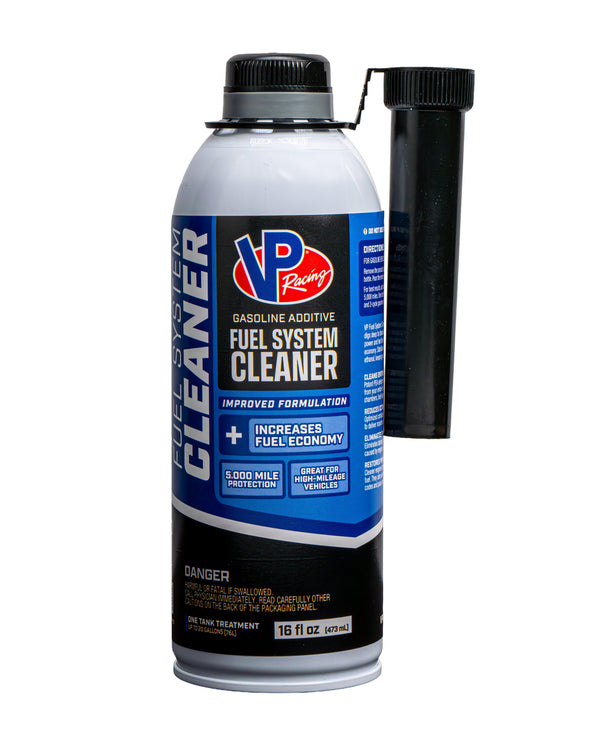
Think of it this way: throttle body cleaning handles what you can reach from the outside. VP Fuel System Cleaner handles everything downstream, working through the fuel itself to dissolve the deposits that a spray and a brush can't touch. Together, they give your engine a complete clean from the air intake to the combustion chamber.
Powered by a potent PEA (Polyether Amine) detergent, it dissolves stubborn carbon deposits, gums, and varnish from your entire fuel system. Here's what it does for your engine:
Using it is simple: Pour the entire bottle into your tank when it's at a quarter-full or less, then fill up. One bottle treats up to 20 gallons of gasoline. Repeat every 5,000 miles for consistent protection. It’s safe for all 4-cycle and 2-cycle gasoline engines and EPA-registered for on-road use.
For even more impact, pair VP Fuel System Cleaner with a cetane booster to sharpen ignition timing and further clean up the combustion cycle. It’s a complete performance tune-up, inside and out.
A neglected throttle body creates problems long before major damage shows up. Knowing where to look helps you act early before performance slips.
Early signs often include delayed acceleration when pulling away. Buildup reduces the air reaching the combustion chamber, resulting in a sluggish response, especially when cold. Regular cleaning restores that immediate, connected pedal feel.
Unstable idle or sudden stalls happen when airflow becomes inconsistent at low RPMs. Dirt around the throttle plate confuses airflow sensors and leads to erratic operation. Pairing throttle body cleaning with a quality fuel stabilizer for car helps keep fuel quality consistent and supports smooth performance across the board.
VP Fuel Stabilizer stabilizes fuel for up to 3 years, preventing the deposit-forming gums and varnishes that contribute to rough running and hard starts. A built-in demulsifier removes water from ethanol-blended fuel, which is one of the most common hidden causes of erratic idle and hesitation. Meanwhile, A-rated corrosion inhibitors protect fuel tanks, lines, injectors, and carburetors from rust and internal wear. If your throttle body is clean but performance is still off, degraded fuel is often the next place to look.
When sensors detect irregularities in the air-fuel mixture, they trigger fault codes. A dirty throttle body is often the root cause. Cleaning it frequently clears those codes and restores the correct operating range without expensive repairs.
Throttle care is about keeping your engine responsive, efficient, and ready for whatever's ahead. At VP Racing, we know that even small maintenance steps lead to real performance gains. Our lineup is built to support airflow, fuel quality, and internal protection, all working together to bring out your engine's full potential.
Whether you're refreshing your throttle body or refining your full fuel system, our products are built to deliver. Once your intake is clean and airflow is restored, protecting what's downstream matters just as much. Quality 10W30 oil reduces internal friction, carries away heat, and keeps engine components lubricated, so the performance gains from a clean throttle body aren't undone by wear happening deeper in the engine. Think of it as the final piece of a complete maintenance routine: clean air in, clean oil protecting everything it touches. And for equipment running on 4-cycle engines, 4-cycle engine oil provides that same level of internal protection built specifically for those applications.
Our products are made for drivers who want more from their machines: more throttle response, more consistency, and more time between repairs. Because performance is something you build, and we're here to fuel it every step of the way.
Throttle body cleaner isn't designed for carburetors. Carb cleaners use stronger solvents tailored for the metal and deposits found in older fuel systems. Using the wrong product in the wrong place can cause damage.
Yes, when used correctly. Clean the throttle body itself and avoid letting cleaner enter the turbo housing or intercooler system.
It can help indirectly. By restoring proper airflow and idle control, it supports more efficient combustion, which may lead to noticeable fuel savings over time.
Some procedures recommend light spraying while the engine runs to burn off residue, but this should only be done with caution and the right instructions. When in doubt, clean with the engine off.
For most vehicles, once every 30,000 miles is sufficient. More frequent cleaning may be needed in dusty environments or high-carbon driving conditions.
Not directly, but it can resolve the underlying issue causing them. After cleaning, some codes disappear once the system recalibrates and readings normalize.


